APT.
If you picture a cyberattack, you probably imagine a lone hacker running an automated script to scan the internet, finding an open digital window, stealing some data, and vanishing in a cloud of smoke. In the industry, we call that opportunistic crime.
But there is a completely different tier of digital warfare happening in the shadows—one that doesn’t rely on luck, shortcuts, or quick exits. These are Advanced Persistent Threats (APTs).

An APT is not a piece of malware or a single hacking tool. It is a highly coordinated, well-funded cyber espionage campaign targeted at a specific organization, infrastructure, or nation-state. Understanding an APT requires shifting your perspective from seeing cybercrime as a technical nuisance to seeing it as a long-term military or corporate espionage operation.
The Anatomy of an APT: Deconstructing the Name
To truly understand what makes these threats so dangerous, you only have to look at the three words that make up the acronym:
-
Advanced: The threat actors behind these campaigns aren’t using basic, off-the-shelf hacking kits. They possess deep technical expertise, often utilizing Zero-Day vulnerabilities (flaws in software that are completely unknown to the public or the vendor) and creating custom, modular malware tailored specifically to bypass the target’s unique defense systems.
-
Persistent: This is the defining characteristic. Traditional hackers want to get in and out quickly before they are caught. APT actors have a long-term objective. They might spend months quietly observing a network, subtly changing their tactics, and maintaining access. If they get kicked out of one system, they have three other backdoor access points waiting in reserve. Their goal is a permanent, invisible presence.
-
Threat: APTs are driven by organized human adversaries. These aren’t automated bots. They are elite teams of software engineers, intelligence officers, and social engineers working in shifts. They are almost universally backed by nation-state governments or massive criminal syndicates with virtually unlimited budgets.
How an APT Works: The Lifecycle of an Intrusion
An APT attack is structured, patient, and highly methodical. While a typical ransomware attack might take hours, an APT lifecycle unfolds over months or even years, typically following these core phases:
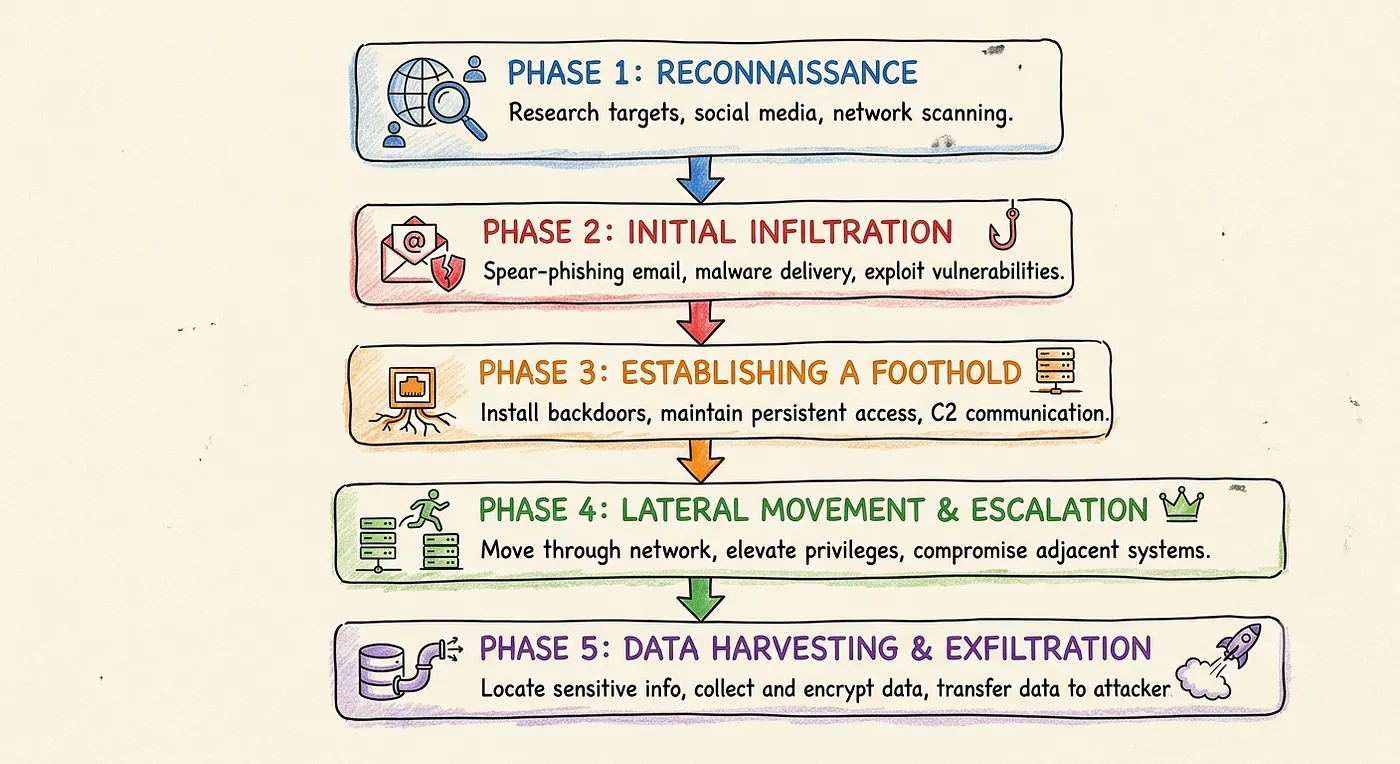
1. External Reconnaissance
Before a single line of malicious code is sent, the APT group spends weeks studying the target. They map out the organization’s network architecture, identify the security vendors they use, and meticulously research employees on platforms like LinkedIn. They look for specific individuals—like database administrators or HR managers—who hold the keys to the kingdom.
2. Initial Infiltration
Once the target is understood, the attackers make their entry. Because automated network defenses are highly advanced these days, the easiest way in is almost always through a human.
APTs frequently utilize hyper-targeted spear-phishing campaigns, supply chain compromises (infecting a smaller, less-secure vendor that has trusted access to the main target), or watering hole attacks (compromising a legitimate website that employees frequently visit).
3. Establishing a Foothold
Once inside, the very first thing the attacker does is ensure they can’t be easily removed. They install custom Remote Access Trojans (RATs) and establish a secure, encrypted connection back to their external servers, known as Command and Control (C2) servers. This traffic is meticulously disguised to look like ordinary, benign web browsing so it blends into the background of everyday network traffic.
4. Lateral Movement & Privilege Escalation
An attacker rarely lands directly on the server containing the crown jewels. They usually land on a low-level employee’s laptop.
From there, they move laterally—using the compromised laptop to scan the internal network, steal legitimate credentials, and compromise adjacent systems. They look for domain controller access, systematically elevating their privileges until they possess administrative control over the entire network.
5. Data Harvesting & Exfiltration
This is the ultimate objective. Rather than stealing everything at once and setting off alarms, the attackers quietly locate sensitive data (such as proprietary source code, intellectual property, military designs, or state secrets). They aggregate the data, compress it, encrypt it, and slowly drip-feed it out of the network over weeks or months to avoid triggering bandwidth anomalies.
Who is Behind APTs?
Because of the sheer amount of money, infrastructure, and time required to execute these campaigns, APT groups are tracked globally by cybersecurity firms and assigned numbers or names (often themed around animals or elements).
| APT Group Designation | Suspected Affiliation | Primary Targets | Famous Operations |
|---|---|---|---|
| APT28 (Fancy Bear) | Russia | Governments, militaries, European security agencies | 2016 DNC Email Leaks |
| APT41 (Double Dragon) | China | Healthcare, tech, gaming, telecommunications | Extensive intellectual property theft and supply-chain attacks |
| Lazarus Group (APT38) | North Korea | Global financial institutions, cryptocurrency exchanges | 2014 Sony Pictures Hack, WannaCry Ransomware |
| Equation Group | United States (NSA) | Telecoms, aerospace, nuclear research | Stuxnet (The highly complex worm that physically sabotaged Iranian nuclear centrifuges) |
Traditional security tools like basic antivirus rely on “signatures”—essentially a digital fingerprint database of known viruses. Because APT actors use custom, never-before-seen malware, signature-based detection is completely useless against them.
Defending against an APT requires a Zero-Trust architecture and advanced Endpoint Detection and Response (EDR) systems driven by behavioral AI. Security teams don’t look for known bad files; instead, they monitor network behavior for subtle anomalies. For example: Why is a marketing computer suddenly executing administrative commands at 3:00 AM and uploading encrypted files to an unknown cloud server in the middle of the night?
In the world of cybersecurity, you can build the highest digital walls possible, but a patient enough adversary will eventually find a way over them. When dealing with an Advanced Persistent Threat, defense is no longer about keeping attackers out—it’s about assuming they are already inside, and having the visibility to hunt them down before they find what they came for.
Copyright © 2026 Mahidul Haque. This post is licensed under a CC BY-NC-ND 4.0 license. You may read, learn, and share links to this post for non‑commercial, educational purposes, as long as you give appropriate attribution. You may not copy, reproduce, adapt, distribute, or use this work commercially without explicit permission.